
Why Does the Same FeCrAl Alloy Show Dramatically Different Lifespan in Different Forms?
In high-temperature FeCrAl projects, a frequent complaint is: “Same grade, same target temperature — why does changing the form halve the life?”
The root cause is rarely the alloy composition itself. It’s an often-overlooked engineering reality: FeCrAl failure is governed by alloy + geometry + stress state.
- The alloy sets the theoretical ceiling (oxidation resistance, max temperature).
- The form determines how close you can safely operate to that ceiling.
Geometry directly controls:
- Surface loading (W/cm²)
- Heat distribution uniformity
- Mechanical stability & sag resistance
- Stress concentration & oxide scale behavior
- Installation & support requirements
Wrong form choice often leads to localized overheating, deformation, early spalling, or inefficient heating. (For alloy basics, see our complete FeCrAl Resistance Wire Guide.)
Below we dissect the main FeCrAl forms, their physics, pros/cons, and real-world fit.
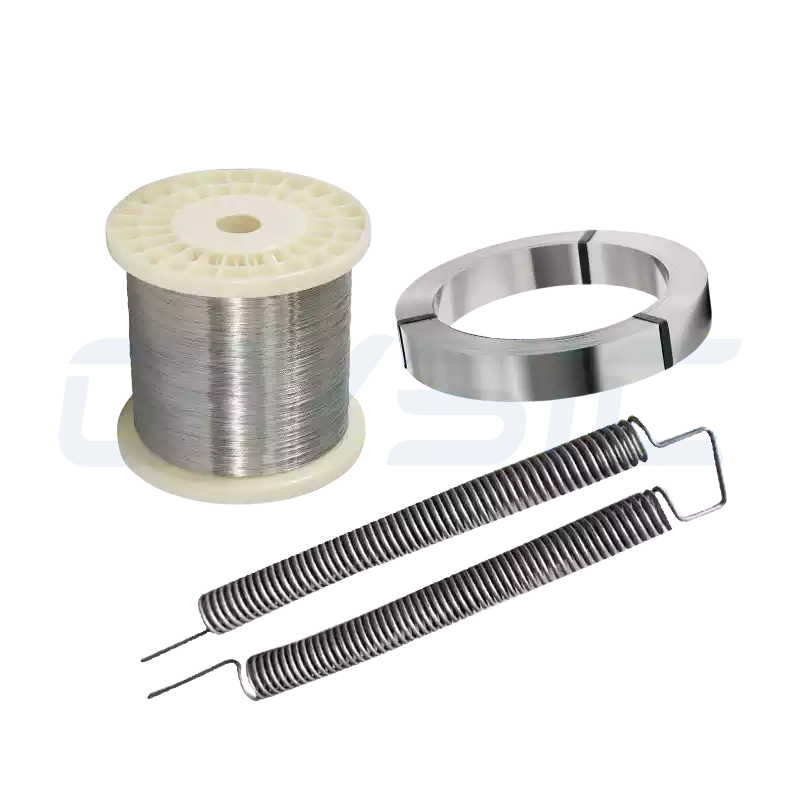
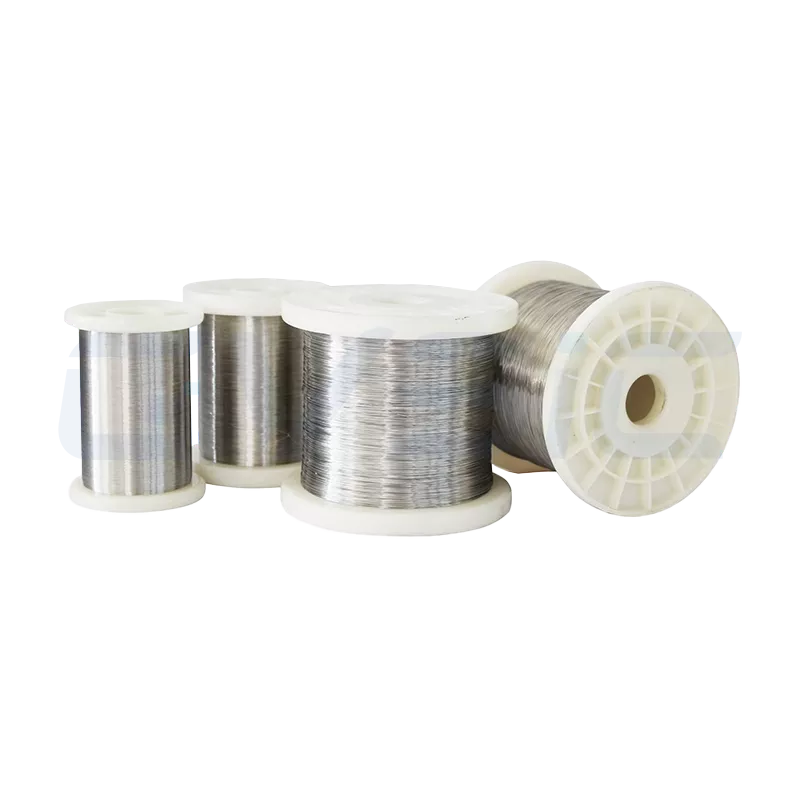
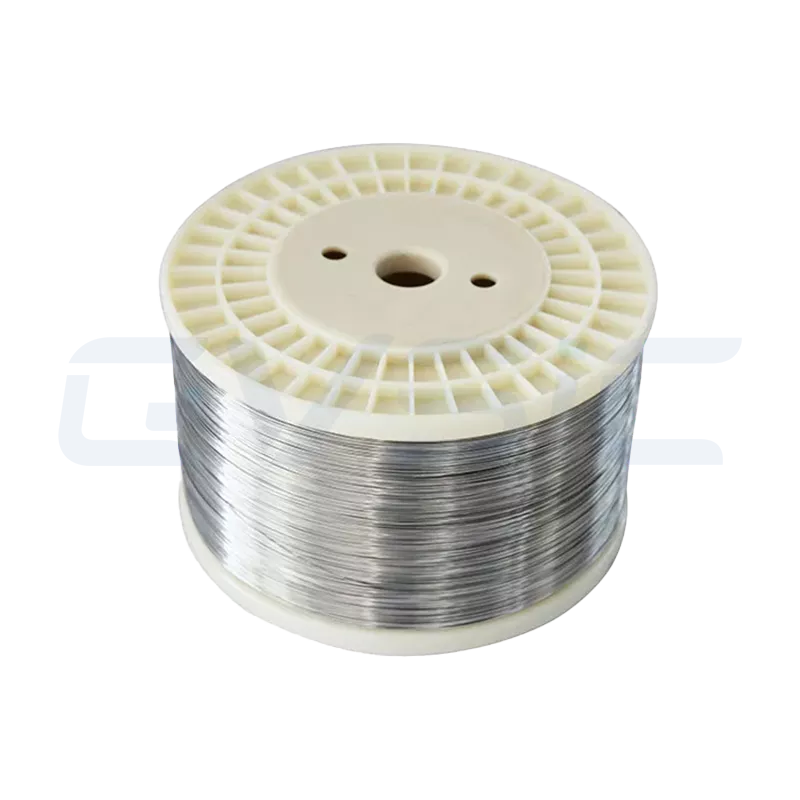
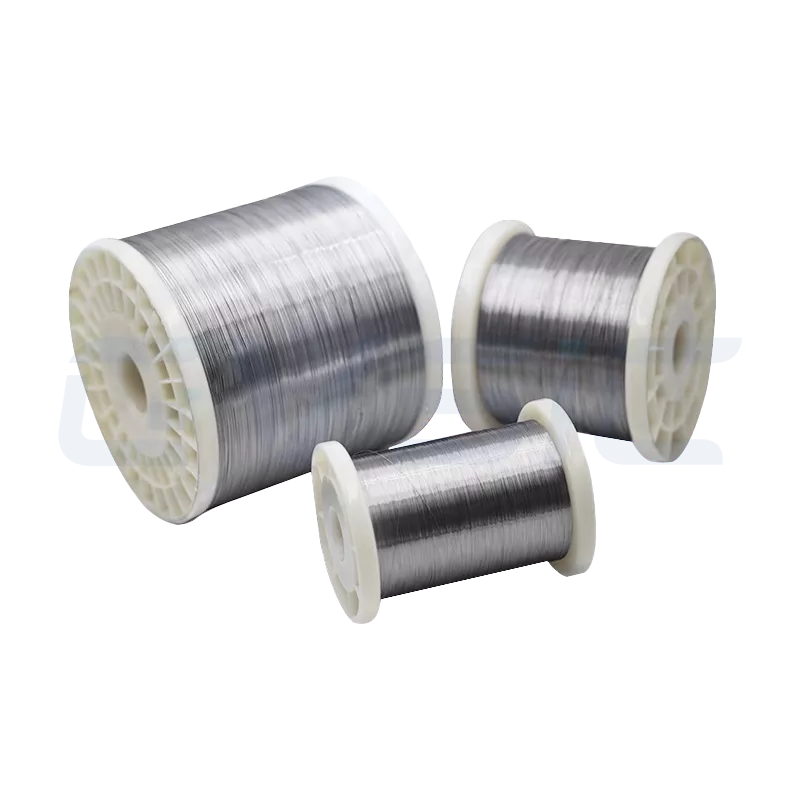
Round Wire — Most Common, Most Predictable, Highest Forgiveness
Description: Continuous round cross-section wire.
Diameter range: 0.05 mm (fine for precision appliances) to >6 mm (heavy-duty industrial).
Surface area/volume ratio: Moderate (~4/d, where d = diameter).
Stress distribution: Excellent uniformity (stress concentration factor K ≈ 1, no sharp corners).
Key physics: Round section ensures uniform resistivity, even circumferential thermal expansion, and continuous, stable Al₂O₃ scale growth.
Advantages
- Highly formable (easy to coil into spirals, waves, or serpentine shapes)
- Lowest cost per kg
- Broadest applicability across furnace types
- Spiral/coil forms deliver excellent radiant efficiency
- Most predictable lifespan due to minimal stress risers
Disadvantages
- Larger diameters (>3 mm) prone to sag under self-weight → requires more ceramic supports
- Lower heat dissipation efficiency vs. flat forms → high-power designs need thinner wire (which shortens life)
Typical applications
- Free-radiating industrial furnace elements
- Embedded groove elements
- Tubular heaters (wound on ceramic tubes)
- Lab furnaces, ceramic sintering, glass melting
Recommended surface loading
- Fine wire (<1 mm): ≤5 W/cm² (low density for appliances/precision control)
- Heavy wire (>3 mm): 8–12 W/cm² (micro-alloyed grades like 0Cr27Al7Mo2 / Kanthal APM equivalents can reach 14 W/cm²)
Why round wire lifespan is the most predictable?
No sharp corners → lowest crack initiation risk during thermal cycling. Uniform oxide growth → gradual, smooth resistance drift (<5% typical).
Engineering tip: For large furnaces >1300°C, prioritize ≥2 mm diameter round wire + high-form-stability grades (e.g., 0Cr27Al7Mo2). See our guide on FeCrAl lifespan factors for more.


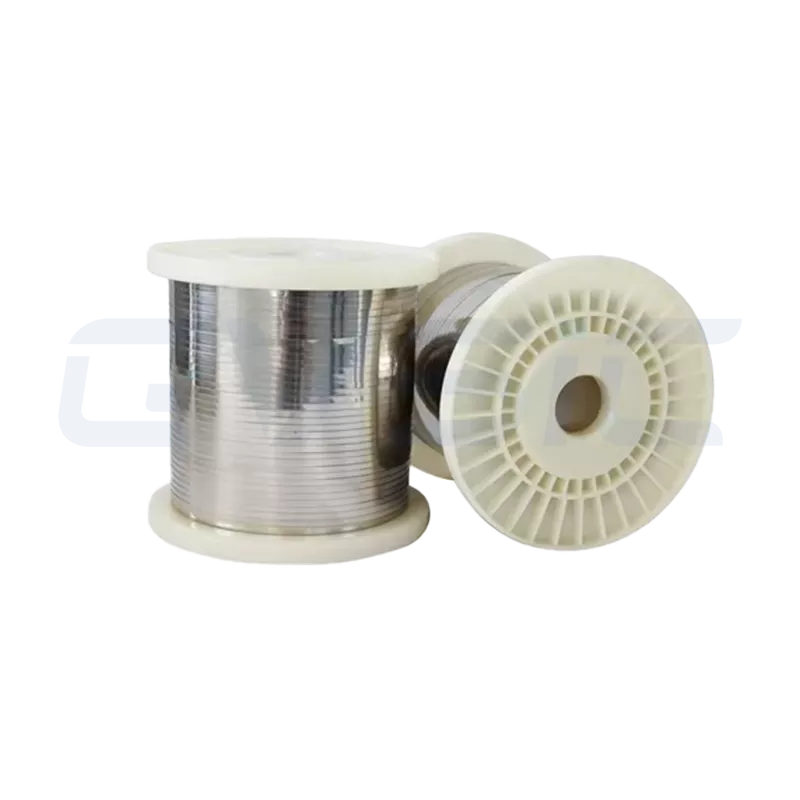

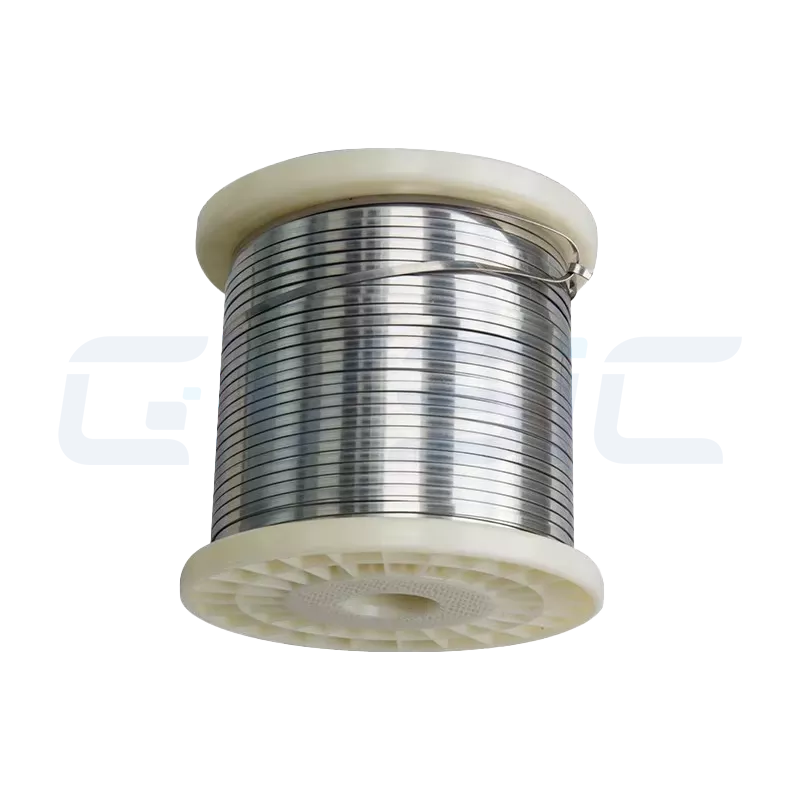
Flat Wire / Ribbon / Strip — Highest Efficiency, Lowest Forgiveness
Description: Rectangular cross-section (common: 0.1×0.4 mm, 0.1×0.9 mm, 0.2×1.0 mm).
Width/thickness ratio: Typically 5–10× (up to 40× in some cases).
Surface area/volume ratio: 1.5–2× higher than equivalent round wire.
Key physics: Flat profile dramatically increases radiating area, lowers thermal inertia (faster response), and shortens required active length for same resistance/power.
Advantages
- Highest practical surface loading (free-radiating corrugated ribbon: 12–15 W/cm²)
- Very low thermal inertia → 20–30% faster heat-up
- Corrugated/zigzag forms offer excellent shape stability & expansion buffering
Disadvantages
- Four sharp corners = natural stress concentrators (K >1.5)
- Bending limited to width direction (thickness direction risks cracking)
- Oxide scale grows unevenly (faster on broad faces, slower at edges → internal stresses)
- Highly sensitive to mounting/alignment errors → localized bending stress
Typical applications
- Domestic appliances (ovens, hair dryers, glass-ceramic hobs)
- Thin-wall furnaces
- High-power-density, fast-response needs
- Food drying equipment
Surface loading edge: Free-radiating corrugated ribbon outperforms equivalent round by 20–30% (per Kanthal data).
Why lifespan is often shorter at same temperature?
Common myth: “More surface area → lower temperature → longer life.” Reality:
- Corner stress + uneven oxide → early spalling
- Extremely sensitive to support/alignment → low fault tolerance
In tightly controlled appliance conditions, ribbon matches round wire life. In industrial vibration/cycling, it often drops to 60–70% of round wire life.
Who should use ribbon?
- Fast heat-up (<30 s to temperature)
- Required >12 W/cm²
- Precisely controlled mounting
Recommendation: 0Cr21Al6Nb ribbon for glass/appliances; avoid >1300°C industrial furnaces unless design is proven.
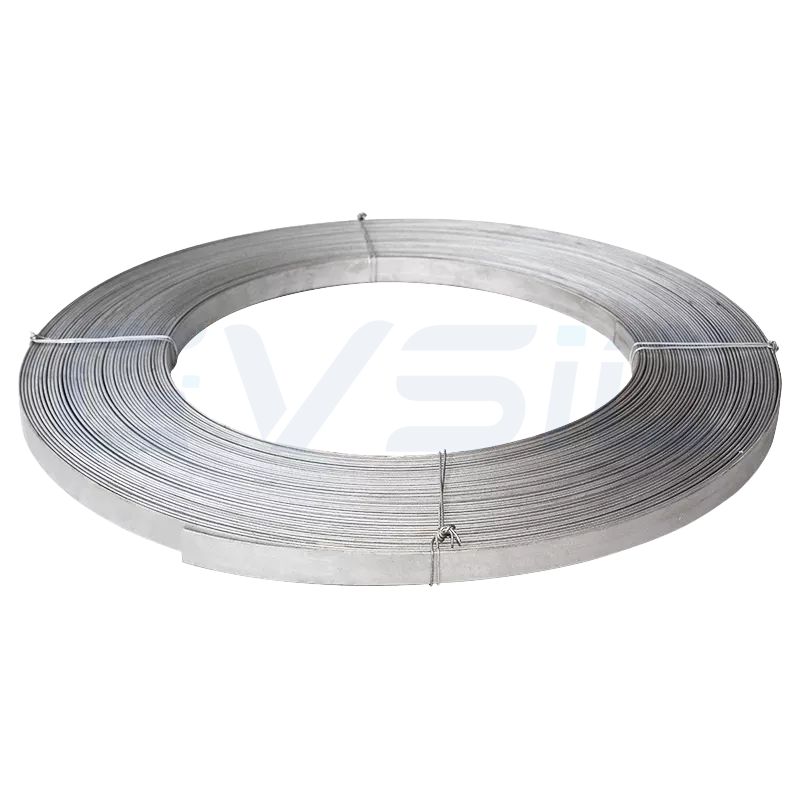
Rod / Straightened Heavy Wire — King of Stability & Longest Life
Description: Large-diameter (≥3–5 mm), often supplied straightened or lightly corrugated.
Key physics: Extreme rigidity, superior hot strength.
Advantages
- Highest mechanical strength & sag resistance
- Ideal for ROB (Rod Over Bend) mounting (corrugated rod on furnace surface)
- Minimal supports needed (long spans)
- Longest predictable life (especially 0Cr27Al7Mo2 / Kanthal APM equivalents at 1400°C)
- Highest surface loading (12–15 W/cm²)
Disadvantages
- Heavier
- Higher forming cost
Typical applications
- Large industrial furnaces
- High-temperature kilns (>1300°C)
- Demanding form-stability needs (ceramic sintering, continuous heat-treat lines)
Engineering highlight: 0Cr27Al7Mo2 rods show far less sag in 1300–1400°C tests. ROB configuration delivers the highest free-radiating load with excellent longevity.
Shaped / Custom Cross-Section Wire — Tailored Solutions
Description: Oval, modified rectangular, or non-standard profiles.
Advantages: Optimized for specific heat patterns, space constraints, or mechanical needs.
Disadvantages: Rare, high custom cost, long lead times.
Typical uses: Specialized furnaces, embedded heaters, precise gradient control.
Form Selection Quick-Reference Table
| Priority Requirement | Recommended Form | Example Alloy Grade | Surface Load Reference (W/cm²) | Lifespan Stability | Key Scenes |
|---|---|---|---|---|---|
| Highest temp + longest life + minimal supports | Rod / Heavy round (ROB) | Kanthal APM / 0Cr27Al7Mo2 | 12–15 | ★★★★★ | Large industrial furnaces, continuous kilns |
| Highest power density + fast response | Ribbon (corrugated preferred) | Kanthal A-1 / AF / 0Cr21Al6 | 12–15 | ★★★☆☆ | Appliances, glass hobs, thin-wall furnaces |
| Best all-round + cost + predictable life | Round wire (spiral/corrugated) | Kanthal A-1 / 0Cr21Al6Nb / 0Cr25Al5 | 8–12 | ★★★★☆ | Most industrial furnaces, lab, tubular heaters |
| Frequent cycling + high thermal shock | Medium-diameter round | Lower-Al variants | 6–10 | ★★★★☆ | Dryers, ovens, circulating heaters |
| Custom heat distribution / space constraints | Shaped wire | Custom FeCrAl | Application-specific | ★★★☆☆ | Embedded / non-standard heaters |
Common Derived Element Configurations
- Helical Coil / Spiral: Most widespread (round or fine ribbon). Coil ID typically 5–8× wire diameter, pitch 2–3× diameter. Used on ceramic tubes or free-radiating.
- Corrugated / Zigzag: Round or ribbon folded into waves. High load + good expansion accommodation.
- Serpentine / Meander: Ribbon common for flat-plate heating.
- Groove-Embedded: Wire/ribbon in ceramic channels — protective but lower load.
- ROB (Rod Over Bend): Heavy corrugated rod surface-mounted — highest load + longest life.
Why “Same Alloy, Different Form” → Huge Lifespan Differences?
One engineering summary: Form changes three critical things FeCrAl is extremely sensitive to:
- Whether the oxide scale can remain stable and adherent
- How uniformly thermal stresses are released
- Whether local weaknesses rapidly propagate to full failure
(See our guide on FeCrAl high-temperature & oxidation principles.)
CVSIC Engineering Selection Recommendations
In real projects, we always probe further:
- Continuous or frequent start-stop?
- Fast ramp-up required?
- Does support allow free expansion?
- Willing to trade some power density for life?
If these questions cannot be answered clearly, we would rather recommend a conservative approach than “selecting based on parameter tables.” CVSIC is a professional electric heating element supplier in China, offering a wide range of furnace heating elements including resistance wire, silicon carbide heating elements, MoSi2 heating elements, and more Custom Heating Elements.
FAQ
Switched from round wire to ribbon — why did life drop?
You gained surface area but introduced stress concentrations and uneven oxide growth. Without matching adjustments to power density and fixturing, shorter life is expected.
Is coiled form always shorter-lived than straight?
Not necessarily — if pitch is appropriate, supports allow movement, and inter-turn overheating is avoided. Poor coil design amplifies every negative factor.
Is there a “safest” FeCrAl form?
No universal safest — only the best-matched to your duty. For most industrial continuous operation, well-sized round wire still offers the highest overall margin of safety.