
Ceramic fiber, also known as refractory fiber, is an inorganic non-metallic material made primarily from alumina (Al₂O₃) and silica (SiO₂). It’s produced by melting the raw materials at high temperatures and then forming fibers through spinning or blowing processes. With fiber diameters usually between 2 and 5 microns, it offers key benefits like low density, low thermal conductivity, small heat capacity, excellent chemical stability, and strong high-temperature resistance.
Ceramic fibers are categorized by alumina content: standard type (Al₂O₃ ≈ 47%), high-alumina type (Al₂O₃ ≈ 52–60%), and mullite type (Al₂O₃ ≥ 72%). Their service temperatures range from 900°C up to over 1600°C.
The main product forms include loose fiber cotton, blankets, boards, papers, modules, and various shaped parts, tapes, and ropes. Through different post-processing methods, the raw loose fiber can be turned into three primary products: ceramic fiber board, ceramic fiber blanket, and ceramic fiber paper. Each has distinct structures, properties, and ideal uses. This article compares them across production processes, physical properties, technical specs, pros and cons, and real-world applications to help engineers and buyers select the right material.
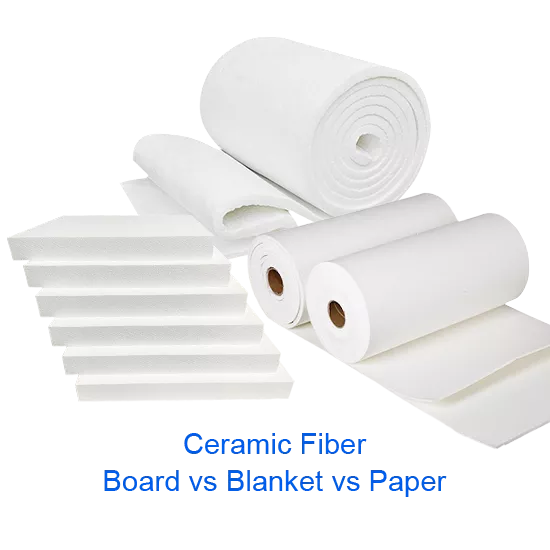
Basic Production Process and Classification
Ceramic fiber production begins with melting the raw materials into fibers. High-purity clay clinker, alumina powder, and silica powder are melted in an electric arc or resistance furnace at temperatures above 1800°C, then formed into fibers using either the blowing or spinning method.
- Blowing method: Produces finer fibers (about 2.0–3.0 μm) with shorter lengths (100–200 mm). The finished products are softer and more flexible but have lower tensile strength.
- Spinning method: Creates coarser fibers (3.0–5.0 μm) with longer lengths (150–250 mm). These offer higher strength and better resistance to vibration and mechanical shock.
Based on composition and temperature rating, ceramic fibers are typically classified as:
- Standard type (1000–1100°C): Al₂O₃ content around 45–47%.
- High-purity type (1100–1260°C): Al₂O₃ content 47–49%.
- High-alumina or zirconia-containing types (1260–1430°C+): ZrO₂ is added to enhance high-temperature stability.
The long-term continuous use temperature is usually 150–200°C below the maximum rated temperature. Bio-soluble ceramic fibers with low biopersistence are also available to improve safety and environmental performance.
Detailed Explanation of the Three Main Product Forms
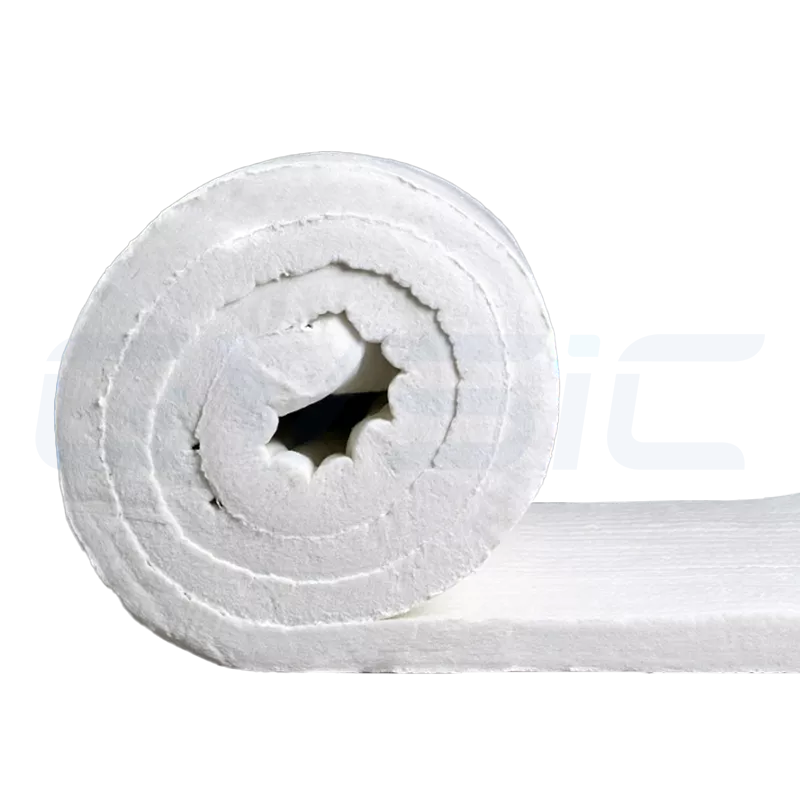
Ceramic Fiber Blanket
Production process: Loose ceramic fiber is laid into a mat using airflow or mechanical methods, then reinforced with a double-sided needling process. This creates a three-dimensional fiber network with little to no binder, as the fibers interlock mechanically.
Key features:
- Form: Soft, compressible, and blanket-like. Typical thicknesses range from 6–50 mm (most common: 10–25 mm and 50 mm). It ships easily in rolls.
- Density: 64–160 kg/m³ (commonly 96 or 128 kg/m³). Higher density improves strength slightly but reduces flexibility a bit.
- Performance: Very low thermal conductivity (0.03–0.06 W/(m·K) at room temperature, staying low even at 1000°C), good temperature resistance up to 1260–1430°C short-term, decent tensile strength after needling, low heat capacity, excellent thermal stability, and fast heating/cooling rates.
- Pros and cons: It’s extremely flexible, making it perfect for wrapping pipes and curved surfaces. It’s easy to install, cut, and adjust in thickness, and being mostly inorganic, it releases almost no smoke or volatiles at high temperatures. On the downside, it has lower compressive strength and may experience minor shrinkage or dusting over long-term use. Workers should take precautions against airborne fibers during installation.
Applications: One of the most common high-temperature insulation materials. Ideal for furnace linings, walls, roofs, pipe insulation, boiler exteriors, heat treatment equipment, flue sealing, and expansion joints. It excels in large-area coverage or flexible wrapping applications like metallurgical furnaces and petrochemical cracking units.
Ceramic Fiber Board
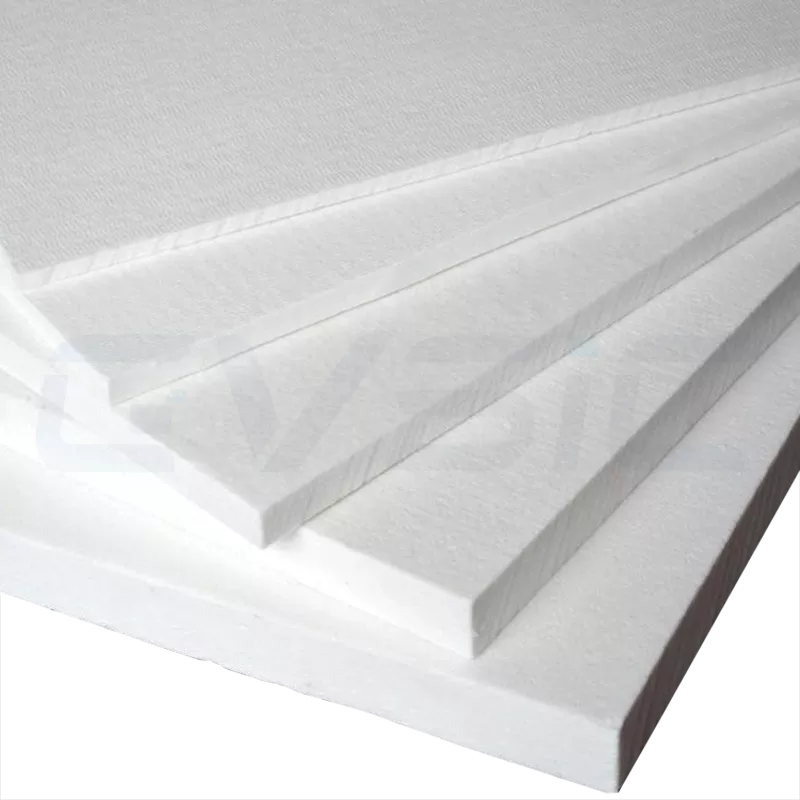
Production process: Made via wet vacuum forming. Loose fibers are mixed with water and a small amount of inorganic or organic binder into a slurry, then vacuum-formed, dried, and cured. The higher binder content creates a rigid board.
Key features:
- Form: Hard, flat boards with smooth surfaces. Thickness usually 10–50 mm, customizable.
- Density: Typically 200–400 kg/m³ (some lighter versions 160–250 kg/m³), much denser than blankets.
- Performance: Thermal conductivity similar to or slightly higher than blankets of the same density, but the rigid structure provides stable thermal resistance. Temperature rating matches blankets (1000–1600°C). Significantly higher compressive and flexural strength, excellent dimensional stability, and good thermal shock resistance.
- Pros and cons: Boards are strong, easy to install and anchor, have smooth surfaces for coatings, and resist erosion well. They work great as structural back-up layers. However, they lack flexibility for curved surfaces, are heavier, and usually cost more. Organic binders may burn off initially, releasing some smoke.
Applications: Best for areas needing flat surfaces and mechanical strength, such as kiln doors, furnace bottoms, hot air ducts, back-up insulation, electric furnace panels, and fire barriers. They’re often paired with blankets—blanket on the hot face and board for support.
Ceramic Fiber Paper
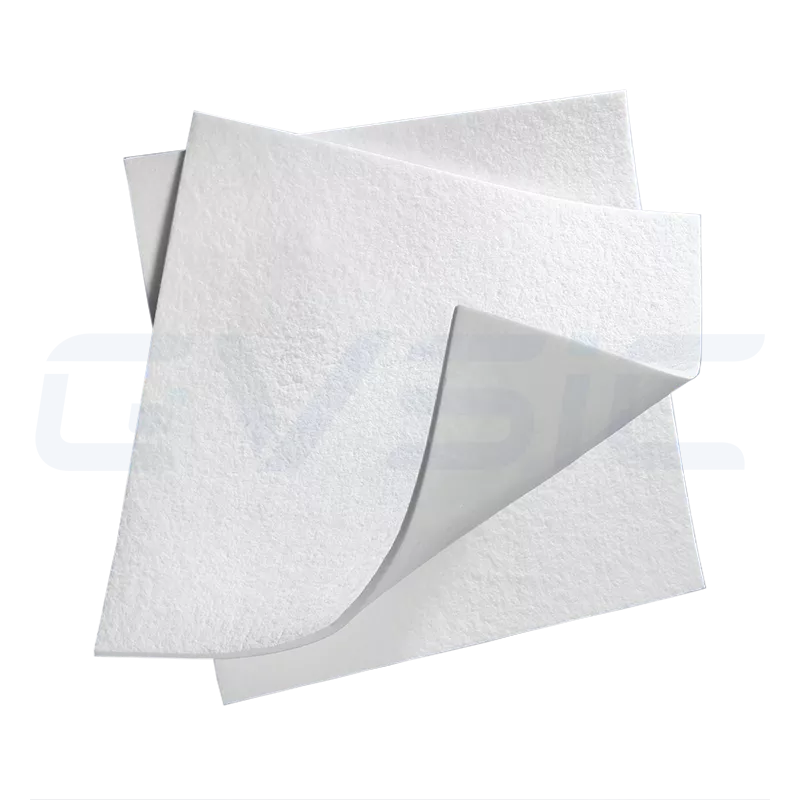
Production process: Similar to traditional papermaking. Fibers are pulped, mixed with organic binders (like latex or starch) and inorganic fillers, then formed into thin sheets, dried, calendared, and heat-treated. Thickness is tightly controlled.
Key features:
- Form: Thin, flexible sheets, typically 0.5–6 mm thick (commonly 1–3 mm), supplied in rolls and easy to cut.
- Density: Around 150–250 kg/m³ with uniform fiber distribution and a smooth surface.
- Performance: Extremely low thermal conductivity for thin-layer use, temperature resistance of 1000–1400°C, plus good electrical insulation and corrosion resistance. The organic binder burns off on first heating, after which performance stabilizes.
- Pros and cons: Excellent for thin, uniform insulation and sealing. It’s more flexible than board and easy to turn into gaskets or pads, delivering high insulation efficiency in thin applications. Drawbacks include lower mechanical strength (tears easily), unsuitability for large unsupported areas, and initial smoke from binder burnout.
Applications: Primarily for precision sealing and thin insulation layers—kiln expansion joints, high-temperature gaskets, furnace door seals, electrical insulation pads, fire doors/walls, and pipe flanges. It’s also used in composites for EV battery thermal protection.
Core Differences Comparison
- Form & Flexibility: Blanket (soft & highly compressible) > Paper (thin & flexible) > Board (rigid)
- Thickness & Density: Blanket (thick, low density) > Board (medium thickness, higher density) > Paper (thin, high density)
- Mechanical Strength: Board (highest) > Blanket (medium, needled) > Paper (lowest)
Installation Fit: Blanket for complex/curved surfaces, Board for flat fixed areas, Paper for precise sealing and gaskets - Thermal Performance: All have low conductivity (0.03–0.12 W/m·K range). Blankets provide higher total resistance thanks to thickness; paper excels in thin layers; boards offer stable performance.
- Cost & Ease of Use: Blankets are cost-effective and quick to install; boards are straightforward but heavier; paper requires careful handling due to lower strength.
- High-Temp Behavior: Blankets and boards are nearly fully inorganic; paper may release minor smoke from organic binders on first heat-up.
Performance Comparison Table
| Performance Indicator | Fiber Board | Fiber Blanket | Fiber Paper |
|---|---|---|---|
| Manufacturing Process | Vacuum forming + curing | Needling interweaving | Wet papermaking |
| Density (kg/m³) | 250–350 | 64–160 | 150–250 |
| Typical Thickness | 25–100 mm | 12.5–50 mm | 1–6 mm |
| Maximum Service Temperature | 1000–1600°C | 900–1600°C | 900–1400°C |
| Thermal Conductivity (800°C) | ~0.25 W/m·K | ~0.20 W/m·K | ~0.22 W/m·K |
| Compressive Strength | Strong (load-bearing) | Weak (soft) | Medium |
| Flexibility | None | Excellent | Good (thin sheets) |
| Processability | Sawing, grooving, drilling | Cutting, folding | Cutting, stamping |
| Thermal Shock Stability | Good | Excellent | Good |
| Relative Cost | Higher | Medium | Medium-high |
Selection Recommendations
| Usage Need | Recommended Product | Core Reason |
|---|---|---|
| Load-bearing, fixed furnace linings | Fiber Board | High rigidity, drillable, surface can face heat directly |
| Large-area coverage or irregular/curved surfaces | Fiber Blanket | Highly flexible, easy to wrap and install quickly |
| Thin-layer insulation, gaskets, precision parts | Fiber Paper | Very thin, uniform, excellent sealing |
| Extreme temperatures >1400°C | High-alumina or mullite fiber board | Superior temperature and chemical resistance |
| Pipe, boiler, and hot air duct external insulation | Fiber Blanket | Easy wrapping, fast installation, good value |
| Smooth surface, wear resistance, low dusting | Fiber Board | Dense surface with minimal fiber shedding |
| Low-temperature back-up layers (<600°C) | Standard fiber blanket | Lowest cost with sufficient insulation |
Installation and Usage Notes
Fiber Board
- Cut with carbide blades for clean, straight edges
- Install in staggered pattern to avoid straight-through joints
- Secure with stainless steel anchors and allow for thermal expansion
- Ramp up temperature slowly during first firing to prevent cracking
Fiber Blanket
- Stagger seams between layers to minimize thermal bridging
- Space anchors no more than 300 mm apart to prevent sagging
- Pre-dry at low temperature if installed in damp conditions
- Always wear gloves when cutting to protect skin from fibers
Fiber Paper
- Ensure flat contact surfaces when using as gaskets to avoid hot spots
- Initial smoke from organic binder burnout is normal
- Store in dry conditions—moisture significantly reduces strength
- Handle carefully after high-temperature use as the paper becomes brittle
General Precautions
- Ceramic fiber is classified as a possible carcinogen (IARC Group 2B). Use dust masks, eye protection, and skin protection with good ventilation.
- Do not clean with acidic or alkaline solutions.
- Store in dry, ventilated areas away from heavy stacking.
- Dispose of used material according to local industrial waste regulations.
Health & Safety Note: Glassy aluminum silicate fibers are IARC 2B possible carcinogens. High-alumina and mullite versions have lower biopersistence and are viewed as safer alternatives in some regions. Always prioritize proper PPE and ventilation on site.
Summary
Ceramic fiber boards, blankets, and papers start from the same raw materials but differ significantly due to their manufacturing methods. This leads to clear strengths in rigidity, flexibility, thickness, density, and suitable applications. Boards are preferred where structural strength is needed, blankets dominate large flexible insulation jobs thanks to ease of use, and papers excel in thin, precise sealing roles.